Showing posts with label Money Tips. Show all posts

Alright now you've either received $900 tax bonus from ATO as part of economic stimulus package or you'll receive soon. The ATO said not to contact them until mid May regarding the payments.

How are you going to spend your $900 tax bonus? Please take the poll below.

Here I've listed some of the things people could do.

  1. Spend it on groceries, clothes, cosmetics, home entertainment systems or gadgets. If you believe spending on made-in-overseas stuffs will promote our economy, that's alright. That's what our Prime Minister and Treasurer want too.

  2. Save it for the rainy days. If you do, you should save it in high interest accounts only. But these days the interest rates are too low to motivate people to save.

  3. Buy shares. The share prices have dropped a lot and there are so much bargain out there. If you pick some strong businesses and invest for a few years, you'll be in a great position. But you must make sure you can sleep well at night.

  4. Contribute to your super. If you're a low or mid income earner, you can contribute it to your super. You can get the benefit of low share prices and co-contribution from the government. But you can't touch it until you are 65.

  5. Pay off your debts. If you have any debt or mortgage, I strongly recommend you do that, especially personal loans or credit card debts.

  6. Donate it to charity. I guess in current economic situation, charities may not be receiving as much donation as they used to. I'm sure they will need it now more than ever.

So what are you going to do with your tax bonus? Please take the poll.

Web polls

Read More......


I have been working on creating a Super Co-contribution Calculator. Superannuation co-contribution is a great way to increase your retirement savings, and it is an Australian Government initiative to help low to middle income earners save for their retirement.

So how much co-contribution can you get from the government?

If you're eligible, you can get $1.5 co-contribution for every $1 you contribute - the maximum co-contribution amount being $1,500. The co-contribution reduces by 5c for every dollar you earn over $30,342 up to $60,342 for the financial year 2008-2009. Use the Super Co-contribution Calculator below to calculate how much you can get.

Calculate Super Co-contribution
Financial Year
After-tax Contribution
Annual Total Income
Government co-contribution *
Your Optimum contribution #


* You are entitled to a $20 of co-contribution if the calculated co-contribution amount is between $0 and $20.

# This is the amount you should contribute to maximize return on your investment.

What are the eligibility criteria?

For the financial year 2008-2009, from 1 July 2008, you will be eligible for the co-contribution if:
  • you make a personal super contribution by 30 June 2009 into a complying super fund or retirement savings account

  • your total income is less than $60,342 (this is indexed annually to reflect changes in average wages)

  • 10% or more of your total income is from eligible employment, running a business or a combination of both

  • you are less than 71 years old at the end of the year of income

  • you do not hold an eligible temporary resident visa at any time during the year lodge your income tax return.

What is Optimum Contribution in the calculator?

If you earn more than $30,342, the co-contribution from the government becomes less and less. For example, if your total income is $40000, the government will chip in $1017.10 whether you contribute $1000 or $678.07. So you're not getting any bonus for extra contribution above $678.07, the Optimum Contribution.

How else can you boost your savings?

You can salary-sacrifice a portion of your salary and invest in your super. Thus you can reduce your taxable income and liable tax too. You won't get co-contribution from the government for that.

Compare Superannuation Funds

Disclaimer: This is just for educational purpose only. The author is not responsible for any consequences or losses due to actions taken solely based on the examples and advices given in this post.

Read More......


Paypal is a very widely used payment method on the net. Ebay uses it. Other online merchants use it to sell their products. I've used it many times (all for small amounts) and it seems quite secure. However there are a few things to notice with using Paypal. I'll talk about Paypal's "Funding Options".

Paypal - Send Money

When you send money to someone using Paypal, the default payment method may be from your debit account. As you can see in the screenshot above "Instant Bank Transfer" from my savings account is the default option, and Paypal states that "Paypal will use Visa xxx xxx to fund this transaction if your bank does not have enough funds."

Well it sounds very easy and simple. Paypal doesn't charge you if it has to use "Backup Source" because you don't have enough funds in your primary source. But the catch is your bank will!!! If you don't have enough funds in your debit account, once Paypal tries to withdraw funds from it, the bank will charge you "dishonor fee", which normally is around $30.

So here are a few tips for how to avoid dishonor fee from your bank while using Paypal

  • Make sure the funding source you select has enough funds

  • DO NOT ever rely on Paypal's automatic backup source option. Your bank may end up charging you hefty fees

  • If you accidentally paid and you realize it doesn't have enough funds, transfer money to that account as soon as possible. Go and deposit it personally. Sometimes Paypal doesn't charge straight away. I got away like that once.

  • If you don't have enough funds in default funding source, click "change" and choose another source with enough funds


Paypal - Funding Options

Paypal - Funding Confirmation
Once again, Don't rely on Paypal's automatic backup source option.

Read More......


When was the last time you shop around your car insurance (Comprehensive or Compulsory Third Party Personal (CTP) or Third Party Property)? Are you disappointed because the premium was increased a lot compared to last year?

If you have never shopped around or haven't shopped around for at least a few years, chances are you may be paying more (a lot more) than what you should be paying.

Today I decided to do some research about comprehensive car insurances and it was quite an eye-opening experience. The premiums differ a lot between different insurers and some of the "famous" brands did not live up to their fame.

I used the following information for comparing insurance premiums among AAMI, NRMA, ING, GIO, YOUI, Justcar, Allianz, Commbank and Budget Direct. Please note that I did not consider the quality of customer services and repairs, ease of claims, etc in it.

Location: Sydney City, NSW 2000

Car Type: 2008 TOYOTA COROLLA ASCENT ZRE152R F/INJ 4 DOOR SEDAN 4 CYL 1.8L 4 SPEED AUTOMATIC

Age of Driver: 30

Year first licensed:1998

Car Use: Private (including to or from work)

Any other car: No

Any non-standard accessories or fittings: No

Current mileage:100km

Finance: No finance

Purchas price: $22000

Parking: Garaged

Additional driver: No additional driver specified but the option is set to cover any one who drives this car


InsurerAnnual PremiumStandard ExcessExtra Excess for This Driver
AAMI$842$550$0
Budget Direct$930$600$0
Allianz$1115$550$0
Justcar Insurance$1133$600$700!!
Commonwealth Bank$1206.65$600$0
Youi$1258.59$600$0
NRMA$1306.55$600$0
ING$1425$500$0

GIO didn't give me any online quote.

So AAMI offers the best price for this situation, followed by Budget Direct, which has been voted as the best by Cannex Star Ratings across all states. I tried my own situation and Budget Direct gave me the best premium. Justcar doesn't seem to like new cars (at least 2008 TOYOTA COROLLA ASCENT ZRE152R)!!!

My two cents: people should shop around or do research before they buy insurance.

Disclaimer: This is just for educational purpose only. The author is not responsible for any consequences or losses due to actions taken solely based on the examples in this post.

Read More......


I've listed some Australian sites that will help you persoanl finance with researching, comparing and choosing superannuation funds, savings, term deposits, loans, credit cards and property prices. Before you do anything with your finances, use relevant links to do some research and it will save you big bucks.

Choose Best Superannuation Funds

Super Ratings

Selecting Super

Invest Smart


Home Loans, Credit Cards, Saving & Transaction Accounts, Term Deposit Comparisons

Info Choice


Property (Houses and Apartments)

For Sale Listings

Real Estate

Domain

Residex FindMeAHome (shows all houses for sale in a suburb, with an estimated fair price)


Suburbview (searches the Suburbs you want from Australia’s Largest Real Estate sites)


Suburb Profiles (Suburb Research)

Domain Suburb Profile

RP Data Free Suburb Profile

Check Property Price Report by SMS (Home Price Guide)

InvestSmart (median price, rental yield and 12/24/36 month growth stats for any suburb)


SQM Research (Demographics and Vacancy Rates of suburbs)


Past Sold Property Prices

OnTheHouse

OldListings (tracks changes in advertised price of properties for sale)

RP Data Auction Results


Property Indices

Residex Indices (historical growth statistics for all capitals)

RP Data Indices (historical growth statistics for all capitals)


Other Property Research

Global Property Guide (for a worldwide perspective)

Herron Todd White ('Month in Review' report)

Westpac Property Outlook

ANZ Property Outlook

Commonwealth Bank Property Value Guide

National Mortgagee & Deceased Data

Read More......


Would-be-first-home-buyers across Australia will be able to take advantage of the Federal Government's first home saver accounts from today.

The accounts will be offered by major financial institutions across the country, including ANZ, Commonwealth Bank, AMP, Members Equity and several credit unions.

Here are some key facts

Key facts

  • No minimum deposit required to open account
  • Limit of $75,000 on overall account balance
  • Flat Government contribution of 17% paid on first $5,000 of individual contributions made each year (you could get max $850 a year for free)
  • Government contributions are tax free
  • Interest earned taxed at 15% (the provider is responsible to pay so they will work out the effective interest for you)
  • Can still claim the First Home Buyers Grant in addition
  • Available through public-offer superannuation providers, life insurers, friendly societies, banks, building societies and credit unions

Potential drawbacks
  • You must contribute at least $1,000 in at least four separate financial years before you can withdraw your funds
  • You must use your fund to purchase or build a new home. The only alternative is to switch the entire amount into your superannuation fund
  • You must live in the home for at least 6 months within the first 12 months of purchase or completion of construction

To find out more about the FHSA, you can also visit the Government’s website.

Read More......


How does $0 airfare sound? Yeah, you heard it right. Air Asia is offering 1,000,000 seats for $0 fare. You only need to pay for the airport tax, surcharges and fees and you'll be on your way to your dream holiday.


Here are the destination on promotions.

Malaysia
Alor Star
Bintulu
Johor Bahru
Kota Bharu
Kota Kinabalu
Kuala Lumpur
Terengganu
Kuantan
Kuching
Labuan
Langkawi
Miri
Penang
Sandakan
Sibu
Tawau

Brunei

Thailand

Bangkok
Chiang Mai
Krabi
Phuket
Chiang Rai
Hat Yai
Ranong
Surat Thani

Indonesia
Bali
Balikpapan
Banda Aceh
Bandung
Batam
Jakarta
Makassar
Manado
Medan
Padang
Palembang
Pekanbaru
Solo
Surabaya
Yogyakarta

Cambodia
Phnom Penh
Siem Reap

Laos

Vientiane

Philippines
Clark (Manila)

Myanmar
Yangon

Singapore

China
Guilin
Guangzhou
Haikou (Hainan)
Hangzhou
(Suzhou, Shanghai, Yiwu)
Hong Kong
Macau
Shenzhen

Vietnam
Hanoi
Ho Chi Minh

Booking is available from 26 - 31 Aug 2008 and will need travel from 1 Apr - 31 Jul 2009.

Don't forget the following tips before you buy the ticket.

  • Best time to log on is between 3 - 7am
  • Tell your friends to rotate on shifts to log on to airasia.com
  • Avoid weekends and public holidays and try for mid week and mid-day flights.
  • If you can't find any free seats on your desired travelling dates, we still have low fares for you to choose from. So hurry, BOOK NOW!
  • Also do try other new destinations if your desired destination is not available.

More details here.

Read More......


Would you believe that it's easier to open a credit card account than to close one?

I heard stories from some of my friends complaining about the banks questioning them whenever they wanted to close a credit card account. But I didn't experience it until last weekend. I have an extra credit card that I got last year just to take advantage of 0% balance transfer offer from a bank I don't want to name. I want to close it now because it has been nearly a year and they are going charge me annual fees. Also the balance transfer was finished months ago. I hardly used that card.

So I went to the bank on weekend to close the account. I was asked why I wanted to close it. After that, the lady tried to ring a department in charge of credit cards, I suppose. Later I was told that the department was closed on weekends and I needed to come back on weekdays.

I went there this morning again. I got questioned again by another teller. After that, she rang to that department and I was told that someone wanted to talk to me. The lady on the phone asked me why I wanted to close it. I said I hardly used it and I didn't want to pay the annual fees for a card I wouldn't need. She said I could close it if I wanted to but if I wanted to stay on with them, they would waive the annual fees for another year. Well, how could I refuse it? Although I wouldn't need it, I will still keep it for one more year for free!!!

I learnt a few things from this experience.

  1. Banks want you to keep in debt especially via credit cards because they carry high interests. They wouldn't be that eager if I were closing a saving account (I don't have millions).

  2. You can and should negotiate with banks if you have loans with them. You'll be quite surprised how much you can save by negotiating.


Note: I do pay back anything I owe on time, so they are not earning interests from me either.

Read More......


I am sure most of you must have used Skype at least once. But I think many Skype users do not use Skype with a cordless phone. Here is a technique I’ve been using with Skype for more than a year. Try it and it can save you a lot, and you don’t have to sit in front of your PC any more.

You only need two things: a USB Skype VoIP to PSTN (RJ11) adapter (shown in picture) and a cordless phone. It doesn’t cost a lot. I paid less than $60 for both.


  1. Install the driver for the Skype adapter.

  2. Connect the Skype adapter to your PC/Laptop with a USB cable.

  3. Connect the cordless phone to the adapter and it’s ready to use. (You can connect your landline (PSTN) to the adapter too to receive normal incoming calls.)


Here are some of the benefits you can get (although some of them may differ in each model).
  1. Make/receive calls from Skype in the same way you use a cordless phone.

  2. No need to be in front of the computer.

  3. You can easily hear when someone calls you from Skype.

  4. Assign hot keys for your friends in Skype and just press them to call your friends from Skype.

  5. Call Hold function for answering the calls from PSTN.

  6. Multiple VoIP applications that you can choose by hot keys, and
  7. Last but not least less phone bill and more contact with your friends & loved ones.


Important: Check system requirements carefully before you buy!!!

Read More......


I’ve seen many people who are so scared of keeping credit cards. One of their reasons was spending the money that you don’t have will financially damage you. On the other hand, some people are very proud of their credit cards. At one of the yahoo groups, I noticed some members boasting which credit cards would give you a better impression when you shop (they were not talking about Gold or Platinum, but from which bank such as Citibank, etc). And they tried to get those credit cards for the sake of impression.

I believe both are extreme ideas. In fact what can give you a better impression than spending your own money, like paying cash for your car or house? Besides, I doubt that a credit card from one bank can give you a better impression than that from another bank. Having said that, credit cards are not necessarily bad if you know how to handle them. There are good debt and bad debt, and if you carry only good debt, it can even give you a financial leverage.

I have a credit card and I want to share some of the tricks I use to earn money from my credit card. Yeah, you heard it right. The money I earn from banks by using this credit card is more than the annual fees I have to pay.

If you read my previous post about Savings Account, you will notice that I can earn nearly 5% per annum interest from my debit account. I keep all the money I would need in short term in that account as long as possible. I use my credit card for almost all expenses, such as rent, groceries, bills, miscellaneous expenses, etc. But I do keep track of my balance and I do make sure that I pay full amount of the closing balance every month so that I don’t have to pay any interest. So I never let any credit go past the “grace period” (the interest free period).

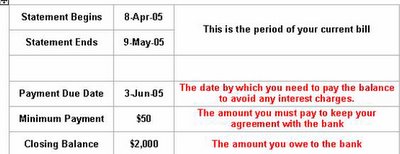
Here are the numbers in your credit card statement you need to give full attention to.

Credit Card Statement Example
As you can see from the picture, if you don’t pay the bank the minimum amount ($50) by the due date (3 June 2005), the bank would send you a warning since you’re breaking the agreement to pay a certain amount back every month. But many people do take it wrong that they will be alright if they pay only the minimum amount. That will surely lead you into more debt since the bank is charging you a massive amount of interest for the rest of the balance; 9% to 19+% depending on the banks.

Since I don’t want to get charged any interest, I do make sure that I pay the “Closing Balance” back during the period (Statement Ends --> Payment Due Date). I just set a low limit for my card and the available credit in my card is nearly $50 any day of any month. I have compulsory expenses every week and every time I need to pay rent or shop, I deposit some money to my card and use it within days if not hours. It’s like I pay for the old balance and get a new balance that I can keep for another grace period (nearly 45 days). Since my monthly expense is around the “Closing Balance”, my credit balance keeps rotating every month although the available credit is nearly zero, and I don’t pay a cent for that.

I admit that I have to pay annual credit card fees about $60. So how do I earn the money back from banks? Instead of paying the debt straightaway like some cautious people & debt-haters do, I take advantage of the “grace period” and keep that money in my debit account. If I could keep only $1200 from credit card in my savings account for the whole year at 5% per annum in this way, the annual fees is paid off. But I do rotate more credit than that by paying rent & bills of some close friends too :-).

Another good thing about using my credit card is I can gain a point for every dollar I spend. When I have enough points, I can claim cash back bonus from the bank. Last week I redeemed 20000 points for $100 cashback. Woo Hoo!!! I still can claim $50 soon too.

So every year I can earn $100+ for using a credit card. You might say it’s not a lot. But, hey, while everyone is paying to use a credit card, I get paid for my credit card & for using someone else’s money in the smart way. It’s totally legal and ethical, and I have the convenience of using a credit card too.

To sum up,
1. Not every credit card is bad, if you know how to manage it.
2. If possible, pay the “closing balance” before the “grace period” and avoid high interest.
3. Rotate your balance & take advantage of “grace period” as I do.
4. Shop around for the best credit card with longest grace period, most bonus points, cheapest annual fees & lowest interest (if you can’t pay the balance).
5. Do not use your credit card for the sake of bonus points.
6. Do not use your credit card for the things you can’t afford to pay in cash within the grace period. (I use it for compulsory expenses that I would have paid in cash otherwise.)
7. Do not keep many credit cards, since "more credit cards = more annual fees".
8. Keep it secure!!!

Don't let banks rob you. Rob them instead!!!

Read More......


Have you ever played any game that teaches you financial literacy? Are you wondering if such game exists at all? Yes, it does. But it isn't Monopoly. All you do in Monopoly is buy, sell and collect money. I've found a much better game than Monopoly, that can teach financial literacy & investment skills. It's so enjoyable to play that you won't even notice that you're learning a lot while you're playing it.

It's Cash Flow 101 game created by Robert Kiyosaki, the best-selling author of "Rich Dad, Poor Dad". Although I read about the game in "Rich Dad, Poor Dad", I didn't have a chance to play it until last week. Once I played a few games and became familiar with it, I've been hooked with it.

As the name suggests, it's all about cash flow, and you've to try to win the game by moving yourself from "Rat Race" to "Fast Track", and then achieving your initial dream. "Rat Race" represents active income (or) salary (or) wages, and "Fast Track" stands for passive income such as investments and businesses. Your financial statement is the most important tool to guide you through the game. You need to prepare and balance it at every stage.
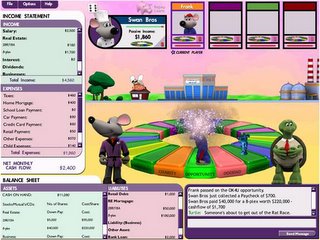
Cash Flow 101: Rat Race
As you can see in the above picture, there are 4 categories in the financial statement: Income, Expenses, Assets & Liabilities. According to Robert, assets are the ones that put money into your pocket, and liabilities are those that take money out of your pocket. I believe this is the most important concept in Cash Flow 101 as well as in the real world. You might think you are buying assets but if the expense of your investment is higher than the income it brings to you, then it will be a liability for you (unless the prices increase and you can sell at a higher price in the future, in other words negative gearing). But Robert doesn't encourage negative gearing, since you might have financial hardship if you can't sell it for a higher price.

The game is quite similar to real life. There are Opportunities (to invest), Doodads (unexpected expenses), Paychecks (income), Charity, Child expenses, Downsize (job loss, etc). If you are in the "Rat Race", your income may be just a bit higher than your expenses. You're financially vulnerable in this stage, so you need to save more money to buy investments that will bring positive cash flow. The more assets you have, the higher your income will be. Thus you can invest more and when your passive income is high enough, you can get out of the "Rat Race".
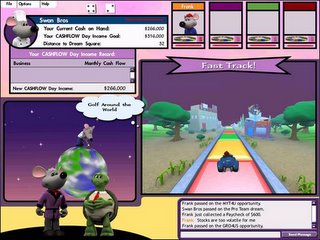
Cash Flow 101: Fast Track
This is the screen shot of "Fast Track". There are more opportunities in "Fast Track". Although there are still unexpected expenses, the damage they can do to you is not significant. This is the life of investors and successful business people.

After you've been in the "Fast Track", you need to achieve your initial dream to win the game, such as buying a yacht, etc. The first person who achieves his/her dream wins the game.
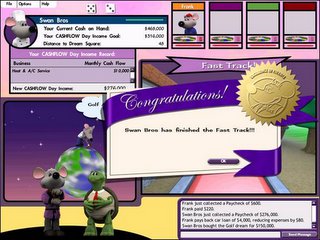
Cash Flow 101: Winner
There are so many things to learn from Cash Flow 101 and all of them are essential skills for every one, but they are hardly taught at school. If you haven't played this game yet, I would recommend you to do so. There is a more advanced version called "Cash Flow 202" that includes bull market, bear market, etc. I can't wait to play it.

Read More......


Don’t Let Banks Rob You

Posted by Swanie | 14.11.05 | | 2 comments »

The other day, I saw some people complaining on TV about how banks are charging a lot of fees. A few years ago, netbanking was totally free, but now some banks are charging 30 cents to 50 cents for any online transaction whether you are paying bills or transferring from one account to the other. Their excuse is they have invested so much for more secure Internet banking. But I don’t think they need to charge customers more. They must be saving more money now because of online banking, since they can reduce the staff numbers. If you don’t believe me, look at the long queue at the banks. Whenever I go to any National or Commonwealth Bank, there will always be a long queue served by only 2 tellers. If they are always thinking about a better service, why don’t they employ enough tellers?

Since banking became an essential part of our daily life, those nasty banks have kept increasing all the fees and charges. Most of the banks in Australia offer very low interest rates for savings accounts (CBA & NAB offer 0.01% per annum interest). I’ve never earned more than 50 cents from those banks in any quarter when I had been their customer. To make matters worse, they charge hefty monthly account fees (more than $5 a month) plus transaction fees if you make more transactions than a certain number allowed, which most of the time is not enough. If you’re living in a country where you don’t have to pay such fees to banks, good on you. Don’t forget that you let them keep your money for “next-to-nothing” interest and you have to pay for withdrawing your own money!!! If you let $1000 sit in a savings account for the whole year without any transaction, what do you think will happen? It’ll surely be less than $1000 at the end of the year, since you’ll have to pay monthly fees.

No wonder National Australia Bank achieved 30% profit rise while Commonwealth Bank exceeded their profit forecast $3.65 billions. These greedy CEO’s and executives rip innocent customers off so that so that each CEO could take millions home as bonuses if the banks’ profits increase. In fact, the consumers have to pay for all those ridiculous bonuses and record-breaking salaries of CEOs’.

If you do not want the banks to rob your hard-earned money, here are some of the ways I learnt from my experience.

1. Do your homework and shop around

Just because you've been with the current bank for so many years doesn't mean you'll have to stick with them. If you don't know about the products being offered by other banks and financial institutions, chances are you may not be getting the best deal you should get. So spare some time to research about the charges & interests offered by different banks ,and "shop around" (it's a magic word for any customer).

My story - I did my homework and found out that my National & Commonwealth savings accounts were costing me instead of paying me, while other banks such as HSBC, ING Direct, Citibank offer more than 4.5% a year without any fees. Of course they do have some conditions about fees & interests. I'll discuss about them shortly.

2. Know how you need to use your bank account

Different people have different needs. Some just need to withdraw only 1 or 2 times a moth, whereas others may need 15+ withdrawls a month. Some prefer electronic Banking such as ATM, others rely mostly on online banking. Or some people might need cheque facility. So check your needs and choose the most suitable product for yourself.

My story - I mostly use online banking for paying bills and transferring money. But I would need to withdraw from ATM or EFTPOS 2 or 3 times a month. This account has to be my main transaction account & I would like a good interest too if possible. After a few days research, I found HSBC had 1 account that suited me perfectly. They offer 4.75% interest whenever you have more than $2000 in the account, free unlimited online banking in Australia, free unlimited number of withdrawls at HSBC ATMs, and 5 free withdrawls at non-HSBC ATMs. So I closed all my accounts with other banks and joined HSBC. Since then, not only I haven't had to pay any more monthly fees or transaction fees, but I also earn monthly interest that's not a joke like 50 cents for 3 months when I was with CBA.

3. Use your precious transaction quotas well

Every time you shop at supermarkets & post offices, use EFTPOS and withdraw some cash too instead of withdrawing later at ATMs. Even if there are any charges for electronic transactions, EFTPOS is cheaper than ATM to use. Some banks offer more free quota for EFTPOS than for ATM.

4. Keep an eye on your bills

Paying your bills on time will give you a good credit rating as well as will help you avoid late payment fees, which often are quite significant. If you don't want to forget to pay your bills, you can set up direct debit from your savings account and the money will be deducted from your account automatically. But you still need to make sure you have enough money in your account for those direct debits. If the money is deducted and you don't have enough balance, you'll have to pay "dishonour fees" that may range from $10 to $45 per item.

To sum up, banks are greedier than ever and they want your money. So if you're not careful, you may end up paying massive amount of fees, and you'll lose twice; once for not earning the interest you should be earning and another for having to pay the unnessary fees. The only thing we can do to defend ourselves against those big banks is to shop around and reward ourselves with the best deal we deserve.

Now I would love to hear what you think and what you have been doing to fight against big banks. If you live in countries other than Australia, please feel free to let me know about the situation in your country.

Read More......


Car Buying Tips

Posted by Swanie | 4.11.05 | | 0 comments »

Here is a good story of Chandler Phillips, a journalist, who went undercover as a car salesman. He learnt all the tricks & traps in the industry, and explained about the people he met: good & bad salesmen/saleswomen. He gave very good recommendations and presented in such a way that it's enjoyablee to read.

Buying a car is not an easy task, especially in these days when the price of a brand new car drops as much as 30% once it leaves the dealer. So here is the summary of his recommendations.

1. Use the Internet
2. Don't be in a hurry
3. Walk away from any deal/salesperson you don't like
4. Know the numbers
5. Shop around
6. The deal's not done until you drive off in your new car
7. Always remember that it's your money

Please visit Edmunds Site for the full story. I hope it helps you when you buy a car next time.

Read More......